
A Guide to Customer Retention Software for Lasting Growth
So, what exactly is customer retention software?
Think of it like the friendly owner of a small-town shop who remembers every regular's name, their kids' birthdays, and exactly how they take their coffee. This software gives your business that same personal memory, but for thousands—or even millions—of customers. It's the engine that helps you turn one-time buyers into genuine, long-term fans.
What Is Customer Retention Software Anyway?
Let's be real: trying to build a solid relationship with someone when you can't remember past conversations or what they like is a recipe for disaster. Businesses face this exact problem, just on a massive scale. This is where customer retention software comes in. It acts as your company's shared brain, pulling together every interaction and data point to create a single, rich profile for each person.
This isn't just a fancy address book. We're talking about understanding the entire customer journey—from their first like on an Instagram post to their purchase history, support tickets, and direct feedback. This 360-degree view is what allows you to ditch generic, one-size-fits-all marketing and start having real conversations.
The Big Shift from Chasing New Leads to Nurturing Loyalty
For years, the business world was obsessed with customer acquisition. It was a constant, relentless chase for new leads. But the numbers tell a different story, and smart businesses are listening. It can cost anywhere from 5 to 25 times more to land a new customer than to simply keep an existing one happy.
This simple economic truth has kicked off a huge strategic shift. Companies are finally realizing that the real gold is in the relationships they already have. You can see this change reflected in market trends, too. The global customer retention software market was valued at a cool USD 27.5 billion in 2023 and is expected to explode to USD 94.7 billion by 2033. This growth isn't just a fad; it shows that businesses everywhere are waking up to the fact that loyalty is the new bottom line. You can dig deeper into the customer retention software market forecast here.
At its core, customer retention software is all about turning raw data into meaningful relationships. It gives you the power to create personalized experiences that make customers feel seen, understood, and valued—not just like another number in a spreadsheet.
To help you understand how these platforms work, let's break down their main jobs and the impact they have on your business.
Core Functions of Customer Retention Software
| Core Function | What It Does | Key Business Impact |
|---|---|---|
| Centralized Customer Data | Gathers all interactions (email, social media, purchases) into one unified profile. | Provides a 360-degree customer view for truly personalized marketing. |
| Automated Engagement | Triggers personalized messages based on customer actions (e.g., a welcome DM). | Keeps customers engaged at critical moments without manual effort. |
| Customer Health Scoring | Analyzes behavior to flag customers who might be at risk of leaving. | Allows for proactive intervention to prevent churn before it happens. |
| Loyalty Program Management | Creates and runs rewards programs to incentivize repeat business and advocacy. | Turns satisfied customers into loyal, vocal brand champions. |
Ultimately, these tools are about one thing: giving you the ability to treat every single customer like they're your only customer. That's how you build a foundation for real, sustainable growth.
The Essential Features of Powerful Retention Tools
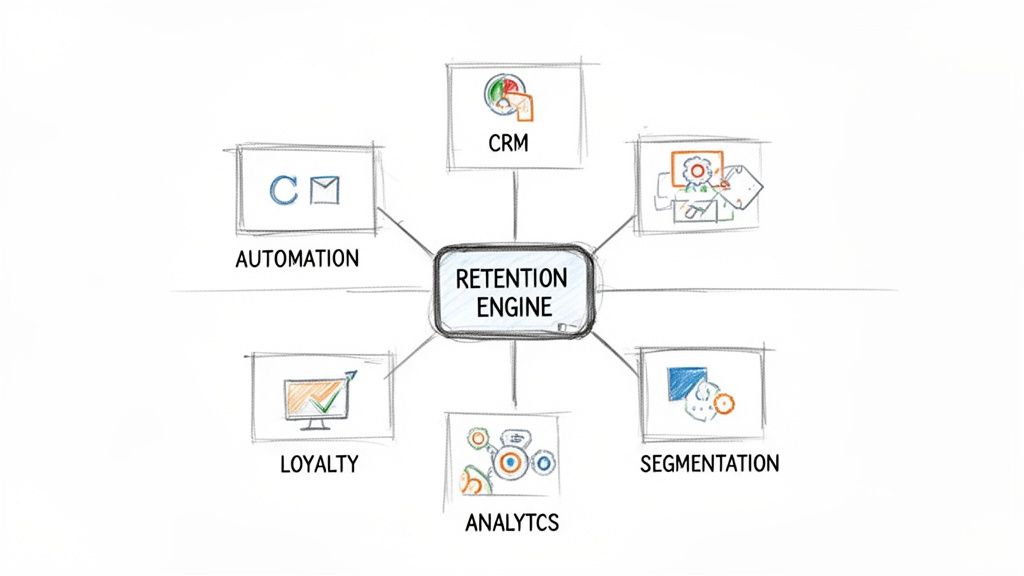
To really get what customer retention software does, you have to look under the hood. It's not just one thing; it's a whole system of interconnected parts working together like a well-oiled machine. Each piece has a job to do, turning raw customer data into actions that build real loyalty.
Think of it like building a championship sports team. You can't win with just a star player. You need a solid defense, a smart offense, and a coach who sees the whole field. In the same way, great retention software combines several core capabilities into one cohesive system for managing and nurturing customer relationships.
These tools are built to automate the personal touch. They let you deliver timely, relevant, and valuable experiences to every single customer, no matter how big your audience gets. Let's break down the essential gears that make this retention engine run.
Unified Customer Profiles and CRM Integration
The absolute foundation of any good retention strategy is knowing your customer, inside and out. That starts with having a single, central place for every piece of information you have on them. This is where seamless CRM (Customer Relationship Management) integration comes in.
Instead of customer data being siloed in your email platform, scattered across social media DMs, and locked in your e-commerce store, the software pulls it all together into one unified profile. This creates a single source of truth for every single interaction.
What it does: It connects to your existing tools to pull in purchase history, support tickets, Instagram comments, and direct messages.
Why you need it: A complete, unified view lets you see the entire customer journey. You'll know if a top Instagram engager has also been a repeat buyer, which means you can tailor your next conversation perfectly.
This complete picture is what powers everything else, turning a bunch of disconnected data points into real, actionable intelligence.
Smart Automation and Personalized Workflows
This is where the magic really happens. Automation features are the workhorses of retention software, carrying out personalized outreach at scale without you having to lift a finger. We're not talking about generic email blasts—these are smart workflows triggered by specific customer actions.
For example, a new follower on Instagram could automatically get a personalized welcome DM. A customer who just made their second purchase could receive a quick thank-you message with a special discount for their next order. These small, timely touchpoints make people feel seen and valued.
A well-designed automated workflow does more than just save time. It ensures no customer falls through the cracks and that key moments in their journey are met with the right message, building a stronger connection with your brand.
For creators and brands, this means you can actually plan out your engagement strategy in advance. You can explore a library of message templates and automation ideas to see how to apply this to your own audience, from welcoming new followers to re-engaging old ones.
Audience Segmentation Tools
Let's be real: not all customers are the same, so why talk to them like they are? Segmentation is the feature that lets you slice your audience into smaller, more targeted groups based on shared characteristics. This is how you move from shouting at everyone to having a personal conversation.
You could create segments for:
Top Engagers: The folks who frequently like and comment on your Instagram posts.
Repeat Buyers: Customers who have purchased from you more than once.
At-Risk Customers: People who haven't engaged or bought anything in a while.
New Followers: An audience segment that needs nurturing from day one.
By segmenting your audience, you can send hyper-relevant messages. Imagine sending an exclusive early-access offer only to your most loyal buyers, or a special "we miss you" campaign to those who have gone quiet. This level of targeting makes your outreach dramatically more effective.
Analytics and Performance Reporting
How do you know if all this effort is actually paying off? That's where analytics and reporting come in. The best retention software provides clear, easy-to-digest dashboards that track the key metrics that matter for loyalty and engagement.
This feature moves you from guessing to knowing. It visualizes critical data points like customer lifetime value (CLV), churn rate, and repeat purchase frequency. By keeping an eye on these numbers, you can see which of your strategies are hitting the mark and where you need to make adjustments. It's the feedback loop that helps you continuously refine your approach and prove the ROI of investing in customer loyalty.
Before diving in, it's helpful to know which features are must-haves versus nice-to-haves, depending on the size of your operation.
Essential vs. Advanced Retention Software Features
| Feature | Essential For (Small Businesses/Creators) | Advanced For (Agencies/Enterprises) |
|---|---|---|
| Unified CRM | A single view of customer interactions and purchase history. | Deep integration with multiple data sources (warehouses, BI tools). |
| Basic Automation | Welcome DMs, thank-you messages, and simple follow-ups. | Multi-channel, conditional workflows based on complex behaviors. |
| Simple Segmentation | Grouping by purchase history, engagement level, or tags. | Predictive segmentation using AI to identify at-risk or high-value customers. |
| Core Analytics | Tracking key metrics like churn, CLV, and repeat purchase rate. | Custom dashboards, cohort analysis, and attribution modeling. |
| Loyalty Programs | Simple points-for-purchase or referral reward systems. | Tiered VIP programs, gamification, and experiential rewards. |
| Email/DM Campaigns | Tools for sending targeted broadcasts to specific segments. | A/B testing, send-time optimization, and deliverability analytics. |
Ultimately, the right feature set depends on your goals. A creator might just need solid automation and segmentation, while a large agency will need the advanced analytics and deep integrations to manage multiple clients effectively.
Unlocking the Business Benefits of Customer Retention
Putting your energy into customer retention isn't just about making people feel good; it's a direct path to real business growth and a much healthier bottom line. While chasing new customers often gets all the attention, sustainable success is built by taking care of the relationships you already have. This is where the return on your investment becomes undeniable.
The numbers don't lie. Acquiring a brand-new customer can cost anywhere from 5 to 25 times more than simply keeping an existing one. A small tweak in your focus can have a massive financial payoff.
In fact, boosting customer retention by a mere 5% can pump up a company's profitability by a staggering 25% to 95%. We're not talking about a tiny improvement here—this is a fundamental shift in how your business makes money.
Growing Your Customer Lifetime Value
One of the biggest wins is the direct impact on your Customer Lifetime Value (CLV). This isn't just a fancy metric; it's the total amount of money you can expect to earn from a single customer over the entire course of your relationship. It's the difference between a one-and-done sale and a long-term, profitable partnership.
Think about a customer's journey with your brand. It all starts with that first purchase. But when you use retention software to create consistent, positive interactions—like a personalized thank-you DM or an exclusive offer based on their past buys—that one purchase turns into two, then three, and so on.
Over time, that person stops being just another buyer and becomes a genuine advocate for your brand. They spend more, they come back more often, and they aren't as swayed by a competitor's slightly lower price because they trust you.
This is how CLV grows, and it's the economic engine that powers any smart retention strategy. The right software gives you the tools to automate and scale these critical touchpoints, ensuring no customer ever feels like just a number.
Building an Unbeatable Brand Reputation
In a world overflowing with options, a rock-solid brand reputation is priceless. And guess what? Your customer retention efforts are the bedrock of that reputation. Every positive interaction, every problem you solve quickly, and every personalized message reinforces the idea that you care about your customers beyond the transaction.
This consistency creates a powerful ripple effect:
Word-of-Mouth Marketing: Happy, loyal customers become your best salespeople. They rave about their experiences to friends, family, and followers, creating authentic social proof that no ad campaign can buy.
Increased Trust: When new shoppers see a brand with a dedicated army of repeat customers, it builds instant trust and makes them feel much more comfortable hitting that "buy now" button.
Competitive Advantage: A strong community of fans builds a protective moat around your business. Competitors will find it incredibly difficult to lure your customers away, even with lower prices.
To really get these benefits, you need to understand and use effective strategies. For example, exploring 10 Proven Customer Retention Strategies for SaaS Companies can give you some great ideas. These are the kinds of approaches that build a brand people want to stick with for years to come.
How to Choose the Right Customer Retention Software
Picking the right customer retention software can feel like searching for a needle in a haystack. There are dozens of options out there, all promising the moon, and it's easy to get lost in the noise. But here's the secret: the "best" tool isn't the one with the longest feature list. It's the one that fits your business, your team, and your customers like a glove.
Before you even think about booking a demo, you need a clear picture of what success looks like for you. Are you trying to cut your churn rate by 15%? Or maybe your main goal is to get your top customers to buy more often?
Think of it like this: you wouldn't start building a house without a blueprint. Similarly, you shouldn't shop for software without a clear, measurable goal. This definition of success will be your north star throughout the entire selection process.
Once you know what you're aiming for, you can start looking at platforms through a more critical lens. This simple, structured approach will help you slice through the marketing jargon and focus on what actually matters.
Define Your Core Requirements
Before you get wowed by flashy dashboards and cool-sounding features, grab a pen and paper (or open a doc) and make a non-negotiable checklist. This list should be grounded in the reality of your day-to-day operations.
Every business's list will look a little different, but you should start by asking these questions:
What specific problem are we trying to solve? Get granular. Is it that your DMs are a chaotic mess? Do you struggle to follow up with people? Or can you not even tell who your most loyal fans are?
Who on my team is actually going to use this thing? Think about their comfort level with technology. A super-complex platform might be powerful, but if it's a pain to use, no one will, and you've just wasted your money.
What's our absolute max budget? Be honest with yourself. Knowing this number upfront stops you from wasting time drooling over tools you can't afford.
Answering these questions gives you a solid foundation and keeps you focused only on solutions that are a realistic fit.
Evaluate Key Technical Capabilities
With your core needs locked in, it's time to get a little more technical. This is where you figure out how a tool will slot into your current tech stack. A fantastic platform that doesn't talk to your other systems is just going to create headaches.
You'll want to zoom in on three key areas:
Integration Power: Does it connect smoothly with the tools you already live in every day? This means your e-commerce platform (like Shopify), your email marketing service, and—most importantly—your key social channels like Instagram.
Scalability for Growth: The tool you choose today has to grow with you tomorrow. Make sure the platform can handle more customers, more sales, and more team members without crashing or forcing you into a crazy expensive new plan.
User Interface (UI) and Experience (UX): A clean, intuitive interface isn't a "nice-to-have," it's a must. If the software is clunky or confusing, your team will avoid it like the plague. Always ask for a demo and click around yourself to see how it feels.
When you're comparing options, it helps to see a direct, side-by-side breakdown. For a great example, check out this comparison of ManyChat vs. happydms to see how different automation tools stack up for specific use cases.
Assess Pricing Models and Total Cost
Alright, let's talk money. Software pricing is rarely straightforward, and the advertised monthly fee is often just the tip of the iceberg. You have to understand the total cost of ownership before signing on the dotted line.
Look past the sticker price and ask about these things:
Tiered vs. Per-User Pricing: Does the price go up based on how many contacts you have? Or do you pay for every single team member who needs a login?
Implementation and Onboarding Fees: Are there one-time setup charges or mandatory training packages you have to pay for?
Support and Maintenance Costs: Is quality customer support included, or is that a premium add-on?
By mapping out your goals, checking the technical fit, and getting a clear picture of the true cost, you can confidently pick a customer retention software that becomes a genuine asset—not just another line item on your credit card statement.
Putting Retention Workflows to Work on Instagram
Let's get practical. It's one thing to talk about the powerful features of customer retention software, but the real magic happens when you apply them to a specific channel. For so many creators, brands, and agencies, that channel is Instagram—a place built for community and connection, yet notoriously tough to manage once you start growing.
This is exactly where the right tool can transform a chaotic DM inbox and a flood of comments into a well-oiled machine for building loyalty. Instead of scrambling to manually reply to every new follower or trying to remember who your top fans are, you can build automated, yet personal, systems that nurture relationships 24/7.
The goal is to make every single follower feel seen and valued, right from their very first interaction. This proactive approach is what separates brands that just post content from those that build real, lasting communities. Let's break down how you can put these powerful retention workflows into action.
Nail the First Impression with Automation
That first interaction you have with a new follower? It sets the tone for everything that comes after. Getting it right is absolutely crucial, but it's an impossible task to do by hand once you have any kind of momentum. This is the perfect job for an automated workflow.
Using a tool like happydms, you can set up a welcome message that automatically slides into the DMs of every new follower. And this isn't just a generic, "Hey, thanks for following!" A smart welcome sequence can do so much more:
Introduce Your Brand: Quickly share what you're all about and what they can expect from your page.
Ask a Question: Kick off a genuine conversation by asking what brought them to you or what they're hoping to learn.
Offer Immediate Value: Give them a little something right away—a discount code, a link to a free guide, or a piece of exclusive content.
This single automated action makes new followers feel instantly acknowledged and opens the door for a real two-way conversation. You're turning a passive follow into an active engagement from day one.
Engage Your Community in Real Time
Retention isn't just about what happens in the DMs. It's about being present where your community hangs out—and on Instagram, that's your comments section. When someone takes the time to leave a comment, a quick acknowledgment shows you're actually listening.
Comment auto-replies are a complete game-changer here. You can set up workflows to automatically respond to comments with specific keywords or even just to all first-time commenters. This simple step ensures no one feels ignored and actually encourages more people to jump into the conversation. If you want to go deeper on these techniques, our Instagram automation course provides step-by-step guidance.
By automating those initial responses, you free yourself up to have deeper, more meaningful conversations with your most engaged followers—the people who really matter.
The flowchart below breaks down the simple process for picking the right software to power these kinds of workflows.
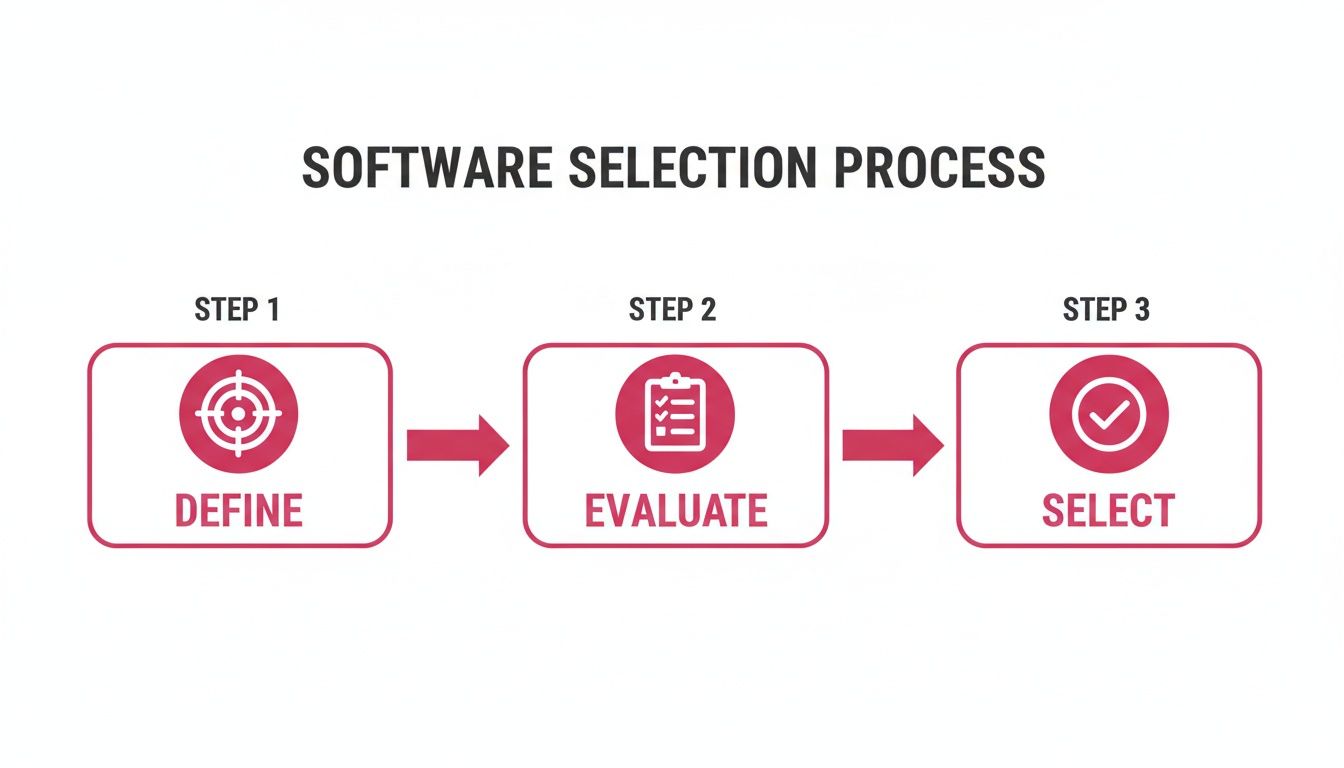
As you can see, it all starts with defining your goals. This ensures you end up with a tool that solves your specific engagement challenges on a platform like Instagram.
Segment and Nurture Your Audience Like a Pro
Now we get to the really powerful stuff. This is where a true customer retention software shows what it can do. A built-in CRM that syncs directly with your Instagram activity lets you move beyond random interactions and start building a structured retention plan. It automatically sorts your audience into valuable segments.
You can create distinct groups of followers, like:
Top Engagers: The loyal fans who consistently like, comment, and reply to your Stories.
Potential Leads: Anyone who has asked questions about your products or services.
New Followers: A fresh segment you can drop into a dedicated welcome and nurture sequence.
Once you have these segments, you can send targeted mass DMs with offers that are incredibly relevant to them. Imagine sending an exclusive presale link only to your 'Top Engagers' or a helpful tutorial video to your 'Potential Leads.' This is the kind of personalization that turns followers into loyal customers and die-hard brand advocates, transforming your Instagram account into a powerhouse for both revenue and retention.
Key Metrics for Measuring Retention Success
So, you've invested in customer retention software. That's a huge step, but how do you actually know if it's paying off? Without the right numbers to guide you, you're just guessing. Tracking key performance indicators (KPIs) is what turns your retention efforts from a hopeful shot in the dark into a data-backed strategy. It's how you measure your impact, prove ROI, and fine-tune your approach.
Think of these metrics like the dashboard in your car. Every gauge gives you a critical piece of information about how things are running. They tell you when to speed up, when to ease off the gas, and when a problem needs a closer look. Retention KPIs give you that same clear, real-time view of your customer relationships.
There's a reason these tools are catching on so fast. The market for customer loyalty and retention software is expected to hit $18,313.85 million in 2025 and explode to $49,703.98 million by 2032. This isn't just hype; it's driven by businesses finally realizing that keeping a customer is way cheaper and more profitable than constantly chasing new ones. You can explore the full market analysis on metastatinsight.com to see the data for yourself.
Essential Retention KPIs You Must Track
To build a useful retention dashboard, you don't need a hundred different dials. Just start with the core metrics that tell the most important parts of your story. These KPIs work together to give you a complete picture of customer loyalty.
Customer Lifetime Value (CLV): This is the big one—the total amount of money you can expect to earn from a single customer over their entire relationship with you. When your CLV is climbing, it's a solid sign that your retention efforts are working and people are sticking around longer.
Repeat Purchase Rate: This one's straightforward. It's the percentage of your customers who've bought from you more than once. It's a direct measurement of satisfaction and loyalty, showing you exactly how many people liked their first experience enough to come back for more.
Net Promoter Score (NPS): You've seen this before. It's that simple survey asking customers how likely they are to recommend your brand on a scale of 0-10. Don't underestimate its simplicity; NPS is a powerful way to gauge overall satisfaction and predict future growth.
A classic rookie mistake is trying to track everything at once. You'll just get overwhelmed. Start with these three fundamental metrics to build a solid foundation, and then you can add more specific KPIs as your strategy gets more sophisticated.
Understanding Customer Churn Rate
Of all the numbers, churn rate is arguably the most critical vital sign for any business with repeat customers, especially subscriptions. This metric tells you the percentage of customers who stopped doing business with you over a certain period. A high churn rate is like a blaring alarm bell—it's a major red flag that something in your customer experience is broken.
Getting a handle on your churn rate is absolutely essential, and a dedicated SaaS churn calculator can be a huge help here. Even a small reduction in churn can have a massive impact on your bottom line. For creators and brands on Instagram, you can spot early warning signs of churn by keeping an eye on engagement dips with a free Instagram account monitor.
Here are some of the most common questions we get about customer retention software. Getting the right answers can make all the difference in picking a tool that actually works for you.
How Soon Will I Actually See Results?
You'll feel some changes almost right away—things like automated welcome DMs make your workflow instantly smoother. But the real, needle-moving results on metrics like your churn rate or customer lifetime value (CLV) usually start to show up within 3 to 6 months.
Think of it this way: the quick wins come from automation, but the long-term growth is built by consistently using data to make your customer interactions more personal.
Is This Kind of Software Only for Big E-Commerce Companies?
Not at all. That's a common misconception. Modern retention tools are built for everyone, from solo creators just starting out to massive enterprise teams.
In fact, platforms like happydms were specifically designed to give smaller businesses and creators on social media the power to build loyalty without needing a huge marketing budget.
The right software isn't about company size. It's about needing to build and maintain strong customer relationships efficiently—and that's a universal goal.
Can I Connect It With the Tools I Already Use?
Yes, and you absolutely should. Good retention software is designed to play nice with others. Most platforms offer a solid lineup of integrations with popular tools like Shopify, various email marketing services, and, of course, social media channels.
Before you commit to anything, always check out the software's integration list. You want to make sure it fits right into your current tech stack, otherwise, you're just creating data silos and more headaches for yourself.
Ready to turn your Instagram followers into a community of loyal customers? See how happydms can automate your engagement and drive real growth. Start your free trial today.