
A Practical Guide to Workflow Marketing Automation
Ever feel like you need a clone to handle all the repetitive marketing tasks? That's pretty much what workflow marketing automation is: a system you build to automatically manage conversations and actions based on what your audience does.
Think of it as setting up a bunch of simple 'if this, then that' rules for your marketing.
What Is Workflow Marketing Automation Anyway?
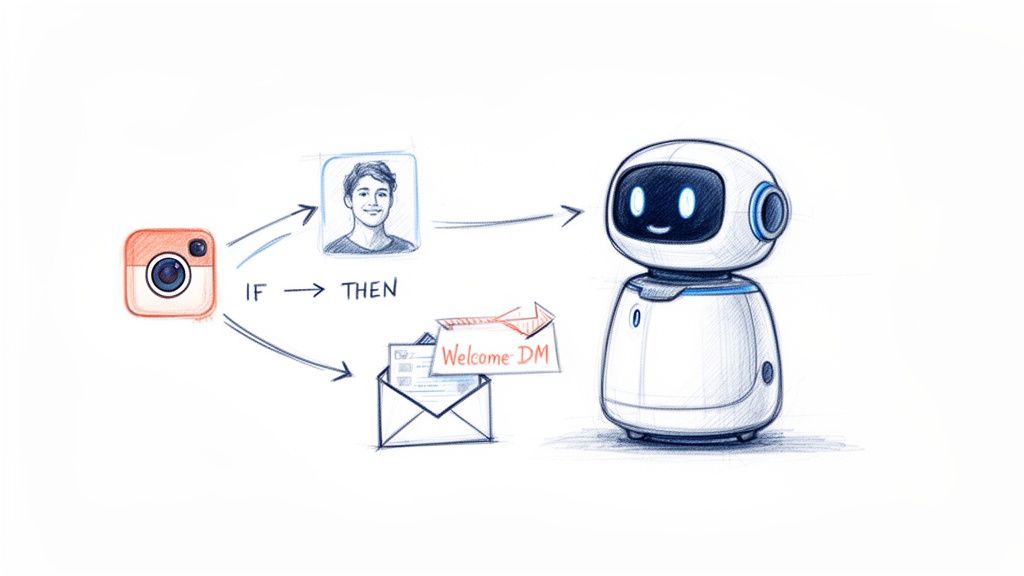
At its heart, workflow marketing automation is all about creating smart, pre-planned sequences that kick in based on your audience's actions, all without you lifting a finger. A perfect example is when someone new follows you on Instagram. A workflow can instantly send them a personalized welcome DM.
This isn't about sending out cold, robotic messages. It's about creating helpful, immediate interactions that you can scale. This way, no follower, comment, or mention ever gets missed, building a foundation of engagement that feels both instant and personal. For small teams and creators, this is a total game-changer.
Tools like happydms are built on this exact logic, freeing you from the manual grind. This lets you focus on what really matters—building genuine connections and growing your brand—while your automated systems handle the initial heavy lifting. If you want to dive deeper into growth strategies, you can find more on the happydms blog
Why Automation Is No Longer Optional
Let's be real: automation isn't just a "nice to have" anymore. Globally, 51% of businesses are already using it, and another 58% of B2B companies are planning to jump on board soon. That's a huge shift, and it means small businesses and influencers simply can't afford to be left behind.
The payoff is massive. Companies often see an 80% increase in leads just by using automated nurturing. The numbers don't lie.
The real magic of workflow marketing automation isn't just about being efficient; it's about being consistent. It ensures every single person gets the right message at the right time, guiding them from a casual follower to a loyal fan without anyone on your team having to do it manually.
The table below breaks down just how much of a difference this makes.
Manual Marketing vs Automated Workflows
| Marketing Task | Manual Approach (The Old Way) | Automated Workflow (The Smart Way) |
|---|---|---|
| Welcoming New Followers | Manually check for new followers and send DMs (when you have time). | Instantly send a personalized welcome DM the moment they follow. |
| Replying to Comments | Scroll through notifications to find and reply to comments one by one. | Automatically send a DM to anyone who comments on a specific post. |
| Lead Nurturing | Send sporadic emails or messages, hoping to catch them at the right time. | Trigger a sequence of helpful messages based on their specific actions. |
| Gathering Feedback | Occasionally post a survey and manually collect the responses. | Send an automated DM asking for feedback after a specific interaction. |
It's clear that automation doesn't just save time; it creates opportunities that are impossible to catch manually.
This whole approach turns marketing from a long list of separate to-dos into a smooth, connected journey that runs on its own. To see how these ideas apply specifically to smaller operations, check out this practical guide to marketing automation for small businesses
Ultimately, it gives even the smallest teams the power to deliver a polished, professional experience that, not too long ago, was only possible for massive corporations with huge marketing departments.
The Building Blocks of an Effective Workflow
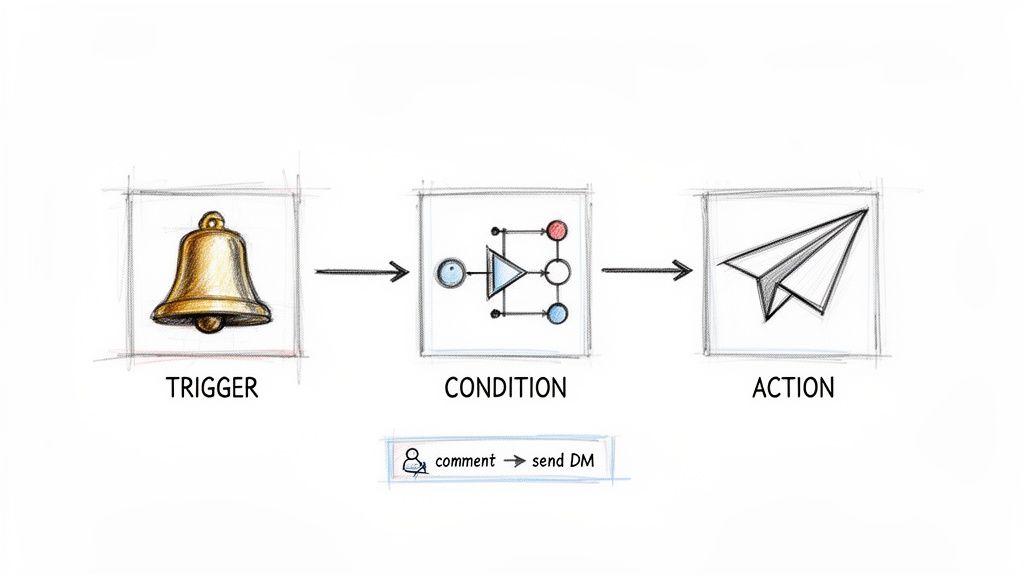
Every powerful workflow, no matter how complex it looks on the surface, is built from just three simple components. Think of them like LEGO bricks—you can combine them in endless ways to build something amazing. Getting a handle on these core elements is the first step toward building your own effective workflow marketing automation.
The three essential building blocks are Triggers, Actions, and Conditions. Once you see how they work together, you'll be able to map out sophisticated customer journeys that practically run themselves.
Triggers: The Starting Gun
A Trigger is the specific event that kicks off your entire workflow. It's the starting gun for the race. Without a trigger, your automation just sits there, waiting for something to happen. This event can be something a user does or a change in their status within your system.
On Instagram, a trigger could be:
A user dropping a specific keyword like "GUIDE" in the comments of your Reel.
Someone giving your account a shout-out in their Story.
A new person hitting that "Follow" button for the first time.
Each of these moments signals that a user is engaged and ready for the next step, making them the perfect starting point for an automated sequence.
Actions: The Task Doer
Once a workflow is triggered, an Action is the task your system performs in response. This is the "then that" part of your "if this, then that" equation. Actions are the real workhorses of automation, taking care of all the repetitive tasks you'd otherwise have to do by hand.
For example, if the trigger was a user commenting "GUIDE" on your post, a logical action would be to:
Send a Direct Message with a link to the free guide they asked for.
Like the user's comment to give them instant acknowledgment.
Add a "Lead" tag to their profile in your system for future follow-ups.
An effective workflow links a specific trigger directly to a valuable action. The goal is to provide an immediate, relevant response that meets the user's expectation, turning a simple interaction into a positive brand experience.
Conditions: The Smart Filter
Conditions are the brains of the operation. They add a layer of logic that acts as a smart filter or a fork in the road for your workflow. Conditions check if certain criteria are met before letting the next action happen, which is how you start to really personalize the experience.
Imagine a user comments "GUIDE," but they've already gotten it from you before. A condition can check for this.
Condition: Does the user already have the "Downloaded Guide" tag?
If Yes: Send a different message. Something like, "Thanks for your interest! Looks like you already have the guide. Can I help with anything else?"
If No: Proceed with the original action of sending the guide link.
This simple check prevents you from sounding like a broken record and makes your communication so much smarter. Building workflows doesn't have to start from scratch, either. You can explore pre-built automation sequences in our happydms Instagram templates
To get your workflows running on solid, data-driven ground, you'll want to make sure you have a robust data pipeline. A good place to start is this Social Media Analytics API Guide
The Real-World Payoff of Automating Your Marketing
Let's move past the theory. When you actually put workflow marketing automation into practice, you get real, tangible results that completely change how you run your business. The idea is simple but incredibly powerful: you're buying back your most valuable asset—time—and pouring it back into the creative, big-picture strategies that only a human can pull off.
Think about it. Instead of manually shooting out DMs, replying to every single comment, or trying to segment new followers on the fly, you build systems that handle these repetitive jobs instantly, 24/7. This isn't just about shaving a few minutes off your day. It's about reclaiming hours every single week, freeing you up to focus on genuine connection instead of constant admin.
This newfound efficiency is a direct line to smarter growth. In fact, a whopping 91% of marketers say automation makes a huge difference in their productivity. On average, it saves them about 2.3 hours per campaign. If you're a social media manager running 50 campaigns a year, that adds up to over 115 hours of your time back. These marketing automation productivity stats
Give Your Lead Nurturing a Serious Boost
Great marketing is all about hitting someone with the right message at just the right moment. This is where automation truly shines, turning your lead nurturing from a hit-or-miss effort into a smooth, guided journey for every single person who shows interest. No one ever slips through the cracks.
For instance, when a potential customer DMs you with a question, a workflow can give them an instant answer and automatically tag them as an interested lead. A few days later, it could follow up with a relevant case study or testimonial—gently nudging them toward a decision without you lifting a finger.
This kind of personalized, timely communication is a game-changer. Automated nurturing can bring in 80% more leads and drive a stunning 77% increase in conversion rates. It's the difference between crossing your fingers and hoping a prospect remembers you, versus actively guiding them to the solution they need.
Dial Up the Customer Experience
In a noisy online world, a fantastic customer experience is your secret weapon. Workflow marketing automation lets you deliver instant, helpful, and consistent responses that make your audience feel heard and appreciated.
Imagine a new follower on Instagram getting a warm, personalized welcome message just moments after they hit "Follow." Or a customer who mentions your brand in their Story receiving an immediate "thank you" DM. These small, automated touchpoints build incredible goodwill and brand loyalty. They create an experience that feels attentive and professional, no matter how big or small your team is. Many businesses look at different tools to nail this, often comparing options in guides like this ManyChat vs. happydms breakdown
At the end of the day, automation empowers you to make smarter, data-driven decisions. By tracking every interaction inside your workflows—every click, every reply, every purchase—you get a crystal-clear view of what's actually working, so you can keep tweaking your strategy for even better results.
High-Impact Instagram Workflows You Can Build Now
Theory is one thing, but seeing workflow marketing automation in action is where the lightbulb really goes on. Let's get out of the clouds and into some concrete examples you can set up right now. These are the kinds of workflows designed to get you immediate results by turning quiet followers into engaged leads and happy customers.
Using a tool like happydms, you can build these automated sequences in just a few minutes. They all follow a simple formula: a specific trigger kicks off a series of pre-planned actions, leading to a genuinely valuable outcome for your business. Think of them as your personal playbooks for Instagram growth that run 24/7.
This visual breaks down how these small, automated actions snowball into big wins for your business—saving time, pulling in better leads, and boosting sales.
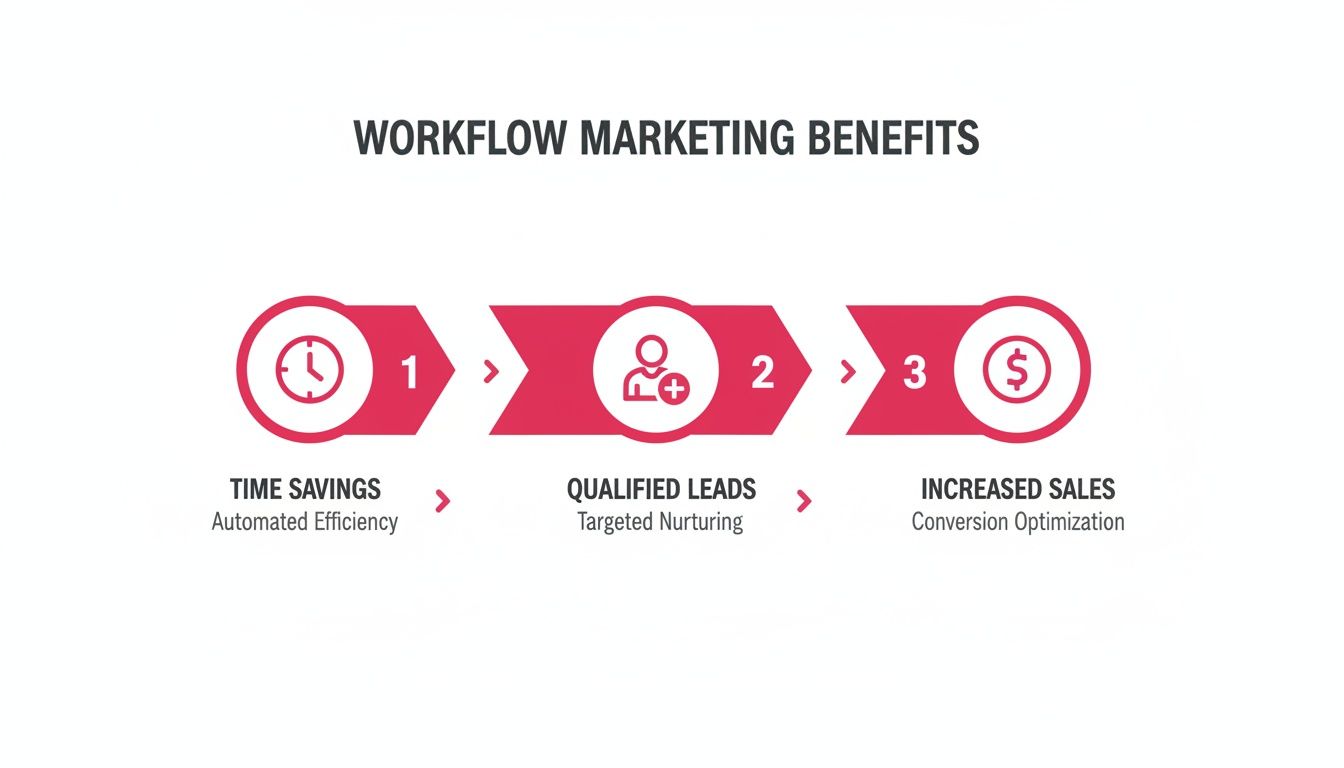
It's easy to see how automating simple interactions compounds into serious growth over time.
The New Follower Welcome Workflow
First impressions are everything, right? That moment someone new follows you is your golden opportunity to start building a real connection. A welcome workflow makes sure you never, ever miss that chance.
Trigger: A user follows your Instagram account.
Action: Immediately send a personalized welcome DM. This isn't a sales pitch—it's a warm hello. You can introduce your brand, ask a simple question, or point them toward a great resource.
Outcome: You instantly make a personal connection, stand out from the noise, and set a friendly tone for the relationship right from the start.
The Keyword Comment Responder
This one is a powerhouse for turning engagement on your posts into actual website traffic or leads. It works by "listening" for specific keywords in the comments on your posts or Reels.
For example, if you post about a new guide, you can tell your audience to comment with the word "GUIDE" to get the link. Our in-depth article explains exactly how to automatically DM someone who comments on Instagram
Workflow in Action:
- Trigger: A user comments on your post with the keyword "GUIDE."
- Action 1: The system automatically replies to their comment publicly, saying something like, "Just sent it to your DMs!"
- Action 2: At the same time, it sends them a direct message with the link to your guide.
- Outcome: You deliver value instantly, give your post's comment count a nice bump, and drive qualified traffic exactly where you want it. It's a win-win-win.
The Story Mention Thank You
User-generated content (UGC) is pure marketing gold. When a follower gives your brand a shout-out in their Instagram Story, it's the perfect time to show them some love and encourage them to do it again.
An automated workflow can keep an eye out for these mentions around the clock.
Trigger: A user tags your account in their Instagram Story.
Action: Send an automated DM thanking them for the feature. You could even toss in a small discount code as a special thank you.
Outcome: The user feels seen and appreciated, making them far more likely to share your brand again. This simple act does wonders for building a strong community.
How to Measure the Success of Your Workflows
Setting up a brilliant automation is only half the battle. If you aren't measuring its impact, you're essentially flying blind.
A successful workflow marketing automation strategy lives and dies by tracking the right Key Performance Indicators (KPIs). This is how you figure out what's working and, more importantly, what's falling flat.
It's easy to get distracted by vanity metrics like your follower count, but real success is found in the data that ties directly to your business goals. For Instagram automation, this means looking past the surface-level numbers and digging into metrics that show genuine engagement and a tangible return. It's how you prove your efforts are actually paying off.
Key Metrics for Instagram Automation
To get a clear picture of how your workflows are performing, you only need to focus on a few core metrics that tell the complete story. These KPIs show you how your audience is interacting with your automated messages and whether those interactions are turning into real business outcomes.
Here are the essential KPIs to have on your dashboard:
Reply Rate: This is the percentage of people who actually respond to your automated DMs. A high reply rate is a fantastic sign that your messages feel personal and engaging, not like they came from a robot.
Click-Through Rate (CTR): When you drop a link in an automated DM—whether it's to a product page, a new blog post, or a lead magnet—the CTR shows you how many people are clicking it. This is a direct measure of how compelling your call to action is.
Conversion Rate: This is the big one. It tracks the percentage of users who take the action you want them to after interacting with your workflow, like making a purchase or signing up for your newsletter. This metric connects your automation directly to your bottom line.
The most effective automations are the ones that are constantly being tweaked and refined based on real data. By keeping a close eye on these KPIs, you can A/B test different message copy, calls to action, and even timing to see what truly resonates with your audience and drives the best results.
Proving Your Return on Investment
Tracking these metrics isn't just about making small adjustments to your strategy; it's about proving the value of your work. The ROI of marketing automation can be absolutely staggering—on average, businesses see a $5.44 return for every $1 spent.
Some workflows, like abandoned cart reminders, are especially profitable. Top performers have been known to earn as much as $28.89 per recipient. You can dive deeper into the profitability of marketing automation
This is where platforms with built-in analytics, like happydms
Common Mistakes to Avoid When Automating
Smart workflow marketing automation is all about building relationships, but when it's done poorly, it can break them in an instant. The difference usually comes down to avoiding a few common pitfalls that can make your brand feel impersonal or, even worse, just plain annoying. The goal is to connect, not create distance.
One of the biggest mistakes I see is trying to do way too much, way too soon. Diving headfirst into building a dozen complex workflows at once is a recipe for burnout and silly errors. You don't have to boil the ocean. Instead, start small. Pick one or two simple, high-impact workflows—like a new follower welcome DM or a keyword-triggered comment reply—and build your momentum from there.
Another classic misstep is forgetting to inject your brand's unique voice into every single message. Your automated DMs should sound like you, not a machine. Use the same tone, the same emojis, and the same personality that your audience already knows and loves. A robotic, generic message is an instant turn-off.
Sounding Human is Non-Negotiable
Failing to test your workflows is a critical error, and it's one that's easy to make when you're in a hurry. A broken link or a message that triggers at the wrong time can seriously damage your credibility. Before you set any automation live, always run a thorough test from the user's perspective. Click every link, check every condition, and read every message to ensure the experience is seamless.
Along those same lines, never make it impossible for someone to reach a real person. Automation is fantastic for handling repetitive tasks, but it's no replacement for genuine human connection. Always give people a clear and easy way to ask a question or get help from you or your team. A simple line like, "Just reply to this message to chat with a real person!" can make all the difference.
Your automation should always feel like a helpful assistant, not a wall between you and your audience. The moment it stops feeling helpful and starts feeling like a barrier, you've lost the game.
Ultimately, successful automation comes down to a thoughtful, human-first approach. Here are a few final watch-outs to keep in mind:
Over-automating: Don't automate every single interaction. You have to leave room for those spontaneous, manual moments of engagement.
Ignoring the data: This is not a "set it and forget it" tool. Regularly check your analytics to see what's working and what isn't, then tweak accordingly.
Forgetting personalization: Use personalization tokens, like a user's first name, to make your messages feel more individual and less like a mass broadcast. It's a small touch that goes a long way.
Of course, even when you're ready to dive in, a few questions might still be bubbling up. Let's clear the air on some of the most common ones so you can move forward with confidence.
Will Automation Make My Brand Sound Robotic?
Only if you let it! The trick is to bake your unique brand personality right into every automated message.
Think about it: you can still use personalization (like a customer's first name), sprinkle in your go-to emojis, and write in the same conversational tone you always do. Automation isn't here to replace you; it's designed to handle the first-touch, repetitive stuff so you have more time for the real, meaningful conversations.
Is This Kind of Thing Only for Big Companies?
Not a chance. In fact, you could argue that workflow automation is an even bigger deal for small businesses, creators, and solo entrepreneurs.
Tools like happydms put the power of a full-scale marketing team into your hands, but without the massive overhead. Automation is the ultimate equalizer, letting you deliver instant, professional service that punches way above your weight class, no matter how big (or small) your team is.
Think of it as your most efficient assistant—one who sounds just like you and works around the clock to nurture leads and keep your audience happy.
Okay, So How Do I Start My Very First Workflow?
The best way to start is to solve your single biggest time-suck. For most people on Instagram, that's manually replying to every single comment asking for a link.
Set up a super simple workflow to tackle this. When someone comments with a keyword like "LINK," your automation can instantly reply to their comment and slide into their DMs with the resource. It's a small change that gives you a quick win and saves you a surprising amount of time right off the bat.
Ready to trade in the manual grind for smart, effective Instagram funnels? happydms has everything you need to build these high-impact workflows in just a few minutes. Start automating your growth today
Frequently Asked Questions
Have a question not in here? Contact us
- What is workflow marketing automation?Workflow marketing automation is a system that automatically manages conversations and actions based on your audience's behavior. It sets up 'if this, then that' rules to handle repetitive marketing tasks without manual intervention.
- How can automation help small businesses compete with larger companies?Automation levels the playing field by allowing small teams to deliver instant, professional responses 24/7. Tools like happydms give small businesses the power of a full marketing team without the overhead costs.
- What are the key building blocks of a workflow?Every effective workflow has three components: Triggers (events that start the workflow), Actions (tasks performed automatically), and Conditions (smart filters that personalize the experience based on specific criteria).
- What metrics should I track to measure automation success?Focus on Reply Rate (percentage responding to automated DMs), Click-Through Rate (link clicks in messages), and Conversion Rate (users taking desired actions). These metrics directly tie to business outcomes rather than vanity metrics.
- How do I avoid making my automated messages sound robotic?Inject your brand's personality into every message using the same tone, emojis, and voice your audience knows. Use personalization tokens like names, reference specific user actions, and always provide a way to reach a real person.
- What's the ROI potential of marketing automation?Marketing automation delivers impressive returns - on average $5.44 for every $1 spent. Some workflows like abandoned cart reminders can earn up to $28.89 per recipient for top performers.
- What are the most common automation mistakes to avoid?Avoid over-automating every interaction, starting with too many complex workflows at once, ignoring performance data, and forgetting to test workflows thoroughly before going live. Balance automation with genuine human engagement.
- How do I get started with my first workflow?Start by solving your biggest time-consuming task. For most Instagram users, this means automating responses to comments asking for links or resources. Set up a simple keyword trigger that replies to comments and sends DMs with the requested information.